
Multi-Agent Architectures: The New Operating Layer for Enterprise Execution
Why specialized, cooperating agents — not a single monolithic model — are becoming the way large organizations turn fragmented operational signals into evidence-backed, human-approved action.
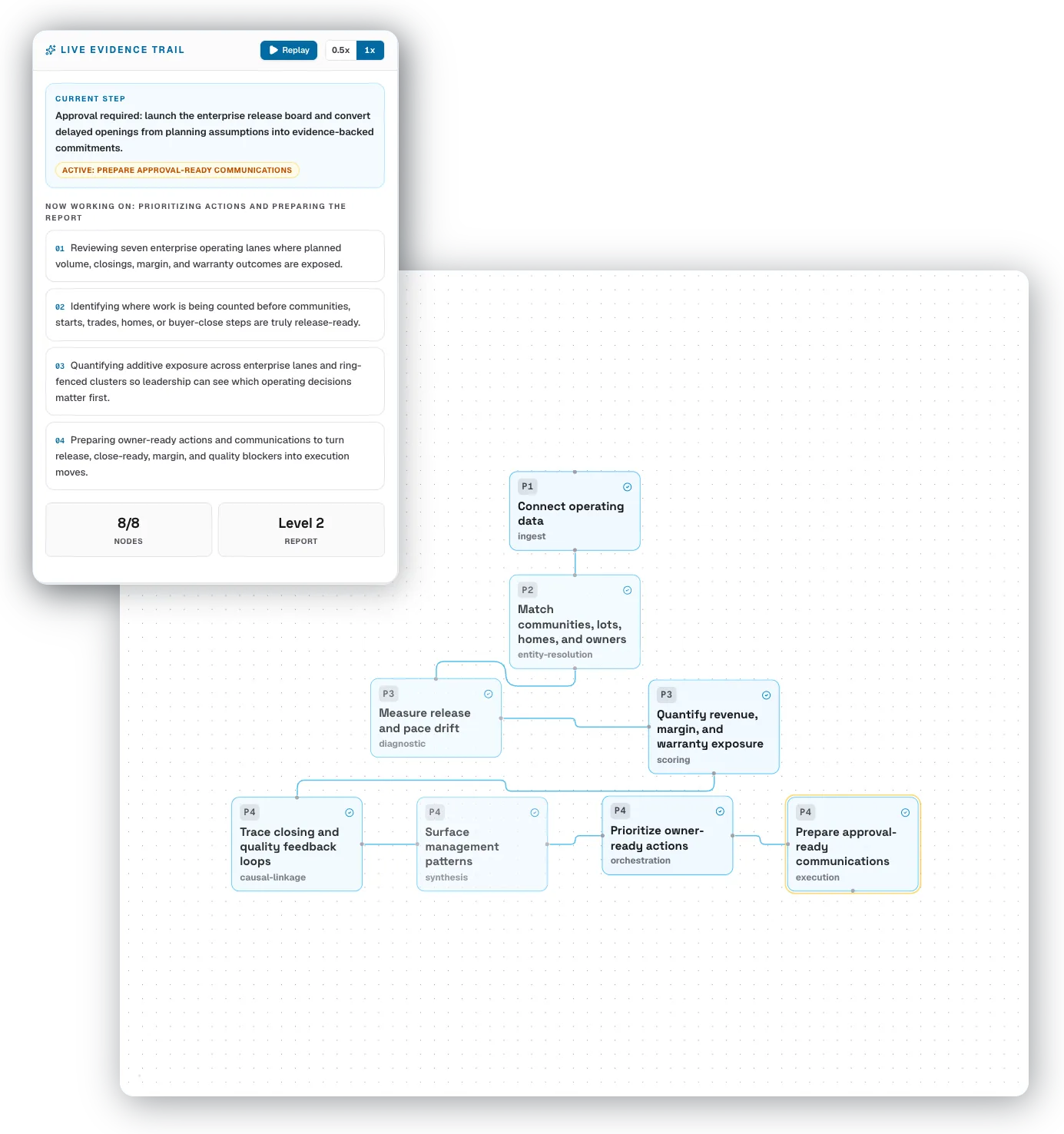
For two years, "enterprise AI" mostly meant a chat box bolted onto a system of record. That phase is ending. Gartner now expects 40% of enterprise applications to embed task-specific AI agents by the end of 2026, up from under 5% the year prior, and the agentic AI market is on a trajectory from roughly $7.8B today to a projected $52B by 2030 [1]. The shift driving those numbers is architectural: from one big model answering questions, to a coordinated team of specialized agents doing the work.
For operations, delivery, and transformation leaders, this matters less as a technology trend and more as a question of execution. Most enterprises don't fail because they lack data — they fail because work stalls between the systems that hold it. Multi-agent architectures are the first AI pattern designed to operate in that gap.
Why one model is not enough
A single large language model can summarize a ticket, draft an email, or answer a policy question. What it cannot reliably do is take a fragmented operational signal — a stalled order in the ERP, a silent customer thread in email, a missed approval in a project tool — and produce a defensible, evidence-backed next step that an operator will trust enough to approve.
The reasons are practical:
- Context windows are finite. A monolithic agent has to choose between depth (deep reasoning over one record) and breadth (a shallow read across many). Real operations need both.
- Reasoning quality degrades with task mixing. Asking the same model to retrieve, diagnose, prioritize, draft, and verify in one prompt produces plausible-sounding output that fails under audit.
- There is no separation of duty. When one component does everything, there is no independent check on its conclusions — which is exactly what enterprise governance requires.
Multi-agent systems address this by decomposition and specialization. A parent orchestrator splits an incoming objective into sub-tasks and routes them to specialist agents — retrieval, reasoning, validation, monitoring — each with its own role, tools, and memory [2]. The orchestrator then synthesizes their outputs into a coherent result. Validation isn't a layer bolted on top; it's a peer agent inside the workflow.
The architectural pattern, briefly
Most production-grade enterprise multi-agent systems share four moving parts:
- An orchestrator that owns the goal and routes work. It decomposes the objective, schedules sub-tasks, and resolves conflicts between agents.
- Specialist agents scoped to narrow domains — a billing-records agent, a contracts agent, a communications-history agent, an SLA agent. Each carries the prompts, tools, and guardrails appropriate to its role.
- A reasoning trace — typically an interleaving of deliberation and tool calls (a pattern formalized as ReAct) — so that every conclusion is bound to the evidence that produced it [2].
- A governance perimeter — policy checks, identity, audit logging, and human-approval gates — that wraps the entire system.
Two open protocols have become the connective tissue of this stack: Anthropic's Model Context Protocol (MCP) for agent-to-tool connectivity, and Google's Agent-to-Agent Protocol (A2A) for agent-to-agent coordination, now governed jointly under the Linux Foundation's Agentic AI Foundation alongside Microsoft, AWS, OpenAI, and others [1]. The practical implication for buyers: a multi-agent architecture built on these standards composes with the rest of the enterprise AI stack instead of fighting it.
What this unlocks for the enterprise
The teams getting real results from multi-agent systems aren't using them as smarter chatbots. They're using them as an execution layer that sits above the operating stack — CRM, ERP, ticketing, project tools, spreadsheets, email, chat — and does four things a single model cannot:
- Reads work in motion across systems. Specialist agents resolve fragmented records into a coherent picture of where a piece of work actually is, who owns it, what's blocking it, and what's exposed.
- Diagnoses, not just describes. Reasoning agents produce a defensible answer to why something is stuck, not just a dashboard showing that it is.
- Prepares an intervention. A drafting agent assembles the next-best action — the email, the approval request, the escalation — with the expected impact and a success signal attached.
- Holds itself accountable. A verifier agent challenges the diagnosis and the draft before either ever reaches a human. Validation built into the architecture is what makes multi-agent systems more reliable than any single component [2].
The early production data is consistent with this. Among enterprises succeeding with multi-agent deployments, operational cost reductions of 35–40% and decision-cycle acceleration of around 50% are common — and the cohort that fails tends to fail on governance gaps, not on model quality [1].
Where Frontier fits
This is the architecture Frontier is built on. The platform connects to the systems that already record the work — CRM, ERP, ticketing, project tools, spreadsheets, email, chat, warehouse — and runs a multi-agent orchestrator above them. Specialist agents resolve work items, monitor stages and dependencies, diagnose drift, rank exposure, and assemble approval-ready actions with the evidence behind them.
A few choices follow directly from how we read the architectural moment:
- Human approval is a first-class step, not an afterthought. Every recommended action carries source evidence, expected impact, a success signal, and a draft communication. The team approves, refines, or rejects before anything is sent.
- The AI is owned, not rented. A system reasoning over email, chat, ERP, and CRM should not export its reasoning — or what it learns from your operation — to a third party. Frontier runs inside your environment, tunes to your operation, and keeps the operating advantage behind your walls.
- No systems are replaced. Frontier sits above the existing stack. The fastest path to value is starting inside one department — delivery, service operations, finance operations — and expanding once the multi-agent loop is producing approved interventions.
The products this enables — the Execution Report, Exposure Map, Action Queue, and Evidence Workspace — are the visible surface of the multi-agent system underneath. The Execution Report is a leadership view of what's stuck and why. The Exposure Map ranks drift by operational risk and revenue leakage. The Action Queue gives frontline managers a prioritized list of approval-ready missions. The Evidence Workspace lets anyone inspect the reasoning trace behind any recommendation — source records, communications, blocker diagnosis, confidence.
What enterprise buyers should ask
If you are evaluating multi-agent platforms — ours or anyone else's — the questions that separate production-ready systems from demos are not about model size. They are:
- Can I see the reasoning trace behind every action, bound to the source evidence?
- Is human approval a structural step in the workflow, or a UI bolted on top?
- Where does my data live and learn — inside my environment, or in a vendor's shared model?
- Does the system compose with my stack via open protocols (MCP, A2A), or lock me into a proprietary one?
- Is governance wired into the architecture from day one — identity, audit, policy — or planned for later?
The enterprises pulling ahead in 2026 are answering those questions in the architecture, not in the slide deck.
Sources
Multi-Agent Orchestration: Enterprise GenAI Architecture 2026 — Innoflexion; As Enterprises Move Beyond Chatbots, Multi-Agent AI Platforms Lead in 2026 — DesignRush News; Agentic AI trends 2026 — Druid AI.
The Orchestration of Multi-Agent Systems: Architectures, Protocols, and Enterprise Adoption — arXiv:2601.13671; AI Agent Systems: Architectures, Applications, and Evaluation — arXiv:2601.01743; Multi-Agent Systems: Architecture, Applications & Real-World Impact — Cognizant AI Lab.