
The New Enterprise AI Playbook: Own the Intelligence, Don’t Rent It
The SaaS era scaled by making software repeatable. The AI era will scale by making intelligence specific — embedded where work happens, governed by your permissions, and owned by the company it runs inside.
For most of the SaaS era, the winning playbook was straightforward: build a product that could work for a very large market, keep the core experience standardized, and make the customer adapt as little as possible.
That model changed enterprise software. It gave companies faster deployment, predictable pricing, continuous updates, and a practical alternative to slow, custom internal systems.
It also created a habit. We learned to think of scale as sameness. The best product was the one that could be sold again and again with minimal change. Customization was treated as an implementation detail: sometimes necessary, usually expensive, and ideally reduced over time.
That made sense when software mostly recorded work.
A CRM recorded pipeline. An ERP recorded transactions. A ticketing system recorded service issues. A project tool recorded tasks. The software mattered, but it was largely a container: a place where work was structured, tracked, routed, and reported.
AI changes the asset.
When AI enters the workflow, software is no longer just a system of record. It becomes a reasoning layer. It reads signals, interprets context, identifies patterns, recommends action, and in some cases acts through other systems.
It starts to understand how the business moves.
That is a much more strategic asset than a dashboard.
The old playbook was built for repeatability
The SaaS playbook rewarded repeatability for good reasons. Investors wanted large markets. Operators wanted lower support costs. Buyers wanted products that could be deployed quickly. The industry learned to build horizontal tools that worked well enough across many companies.
The tradeoff was accepted: the product would not fully understand the business. It would provide structure, visibility, and workflow. The human organization would supply the judgment.
That tradeoff breaks down when AI begins making recommendations.
A generic project management tool can be useful. A generic dashboard can be useful. Even a generic chatbot can be useful for drafting, searching, and summarizing.
But a generic reasoning system is different.
If it is advising leaders on risk, cash exposure, customer commitments, operational blockers, or the next action to approve, “mostly right” is not good enough. The system needs to understand the operating context behind the signal.
A delay is not just a delay. In one company, it may be normal. In another, it may put a customer renewal at risk. A missing approval may be routine in one department and revenue-blocking in another. A quiet email thread may mean nothing, or it may be the early sign that a project is about to stall.
Business judgment is contextual.
Enterprise AI has to be contextual too.
Your data becomes operating memory
The first wave of enterprise AI conversations focused heavily on data privacy. That was necessary, but it is not enough.
The larger issue is control over operating memory.
Raw data is only one piece of the picture. The real value forms when AI learns the company’s workflows, thresholds, language, approval paths, exceptions, escalation patterns, customer commitments, and outcomes.
Over time, those layers become a map of how the business actually executes.
That map is operating memory.
It includes the things that rarely fit neatly into a process document: which handoffs usually break, which approvals create hidden delay, which customer signals deserve attention, which actions actually move work forward, and which patterns tend to repeat before revenue slips or service levels fall.
If that intelligence lives entirely inside an external, generic layer, the company may be renting back a version of its own judgment.
The concern is not simply whether a vendor trains a foundation model on customer data. Serious enterprise vendors increasingly offer stronger contractual and technical controls. The sharper issue is dependency.
Who controls the memory?
Who controls the permissions?
Who controls the retention rules, audit trails, model behavior, integrations, deployment boundaries, and migration path?
If the system becomes part of daily execution, leaving it can be much harder than changing a reporting tool.
That is why AI lock-in is different from software lock-in. Losing a tool is painful. Losing the reasoning layer that understands how work moves through your company is a strategic problem.
Renting AI can make companies more alike
There is another risk that receives less attention: convergence.
When many companies in the same market rely on the same generic AI systems, they may begin to receive similar recommendations. The same “best practices.” The same prioritization logic. The same language. The same sales plays. The same operating assumptions.
At first, that feels efficient. Everyone gets faster. Everyone adopts proven methods. Everyone removes obvious waste.
But competitive advantage rarely lives in the obvious.
It lives in the details: how a company handles exceptions, sequences work, communicates under pressure, interprets customer behavior, manages constraints, and decides what deserves attention first.
If the intelligence layer pushes every company toward the same averages, the market may become more efficient but less differentiated.
The goal of enterprise AI should not be to make every company think the same way. It should help each company understand its own reality more clearly, act earlier, and preserve the operating knowledge that makes it different.
Ownership does not mean building everything yourself
Owning AI does not mean every enterprise should build its own foundation model. That would be unrealistic and unnecessary for most organizations.
Ownership means something more practical.
It means the company keeps control over the operating intelligence created from its own business. It means the AI is grounded in the company’s systems, governed by the company’s permissions, tuned to the company’s workflows, and measured against the company’s outcomes.
It means learned context, decision patterns, thresholds, approval logic, and audit history do not disappear into a black box the company cannot govern or move away from.
In the new playbook, the question is not “Which AI tool can we buy?”
The better question is: “Where should our operating intelligence live?”
That question belongs at the executive level. It touches security, finance, operations, legal, IT, and strategy. It is not just a technology decision. It is a control decision.
The new playbook: embedded, governed, specific
The next generation of enterprise AI will not win by being generic. It will win by becoming safely specific.
That starts with embedding AI where the work actually happens. Not above the business in a vague transformation layer, but inside departments with real workflows, owners, stage gates, communications, approvals, and measurable outcomes.
It also requires discipline.
The right AI system should not dump every piece of company data into one model and hope for a useful answer. It should give each agent or model the right context for the job, keep permissions scoped, verify outputs, show evidence, and keep humans in control where judgment matters.
Most companies do not need another dashboard. They already have dashboards.
They do not need another place to update status. They already have too many systems demanding input.
They need an execution layer that can answer practical questions every day:
What is stuck? Why is it stuck? What value is exposed? Who needs to act? What action is ready for approval? What evidence supports it? What message should be sent? What will prove the action worked?
That is where AI becomes useful beyond productivity.
It moves from answering questions to improving execution.
Why this matters now
AI adoption is no longer the differentiator by itself. Most serious enterprises are already experimenting with AI somewhere in the business. The advantage will come from what happens next.
The companies that win will not be the ones with the most pilots. They will be the ones that turn AI into a governed operating capability: connected to real work, trusted by operators, visible to leadership, and specific enough to improve decisions.
This is the shift from rented intelligence to owned execution intelligence.
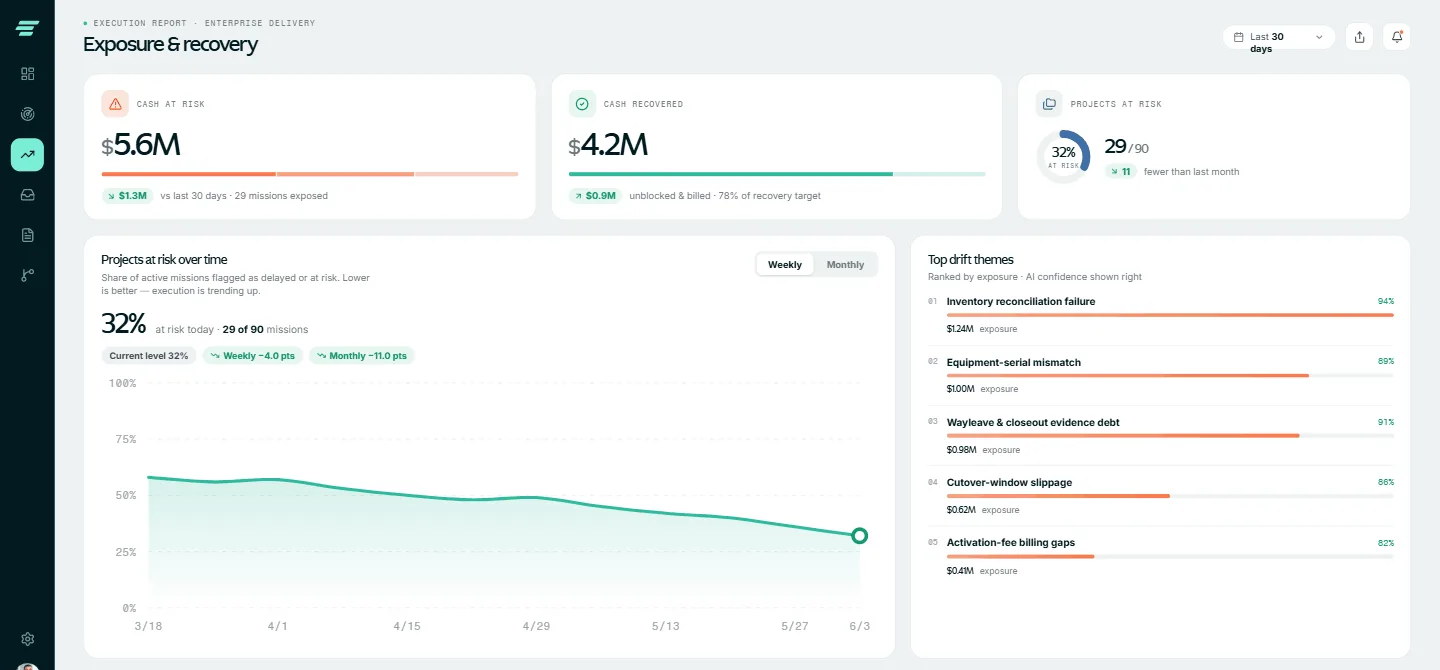
At Frontier, this is the category we are building around: Execution Intelligence. It sits above the systems that already record the work and creates a department-tuned layer for detecting execution drift, diagnosing causes, and preparing evidence-backed actions that keep complex work moving.
The point is not to replace the operating stack.
The point is to make the stack intelligent enough to help the organization act.
Rented intelligence gives you access to capability.
Owned execution intelligence builds capability inside the company.
It compounds because every workflow, exception, approval, blocker, and outcome teaches the system more about how the business actually runs.
That is the future we believe enterprise AI should serve.
Not AI that replaces the judgment of the business.
Not AI that forces every company into the same playbook.
Not AI that sits outside the operating stack and produces another layer of commentary.
AI that learns the business.
AI that keeps work moving.
AI that helps leaders act with evidence, speed, and control.
The SaaS era scaled by making software repeatable.
The AI era will scale by making intelligence specific.
Frontier · Execution Intelligence