
Why We Build AI Products in 90-Day Sprints (And Why You Should Too)
The AI landscape does not stay still long enough for 12-month roadmaps. Here is the full workflow we use to validate ideas in 90 days — and how we bridge a successful prototype into a production product.
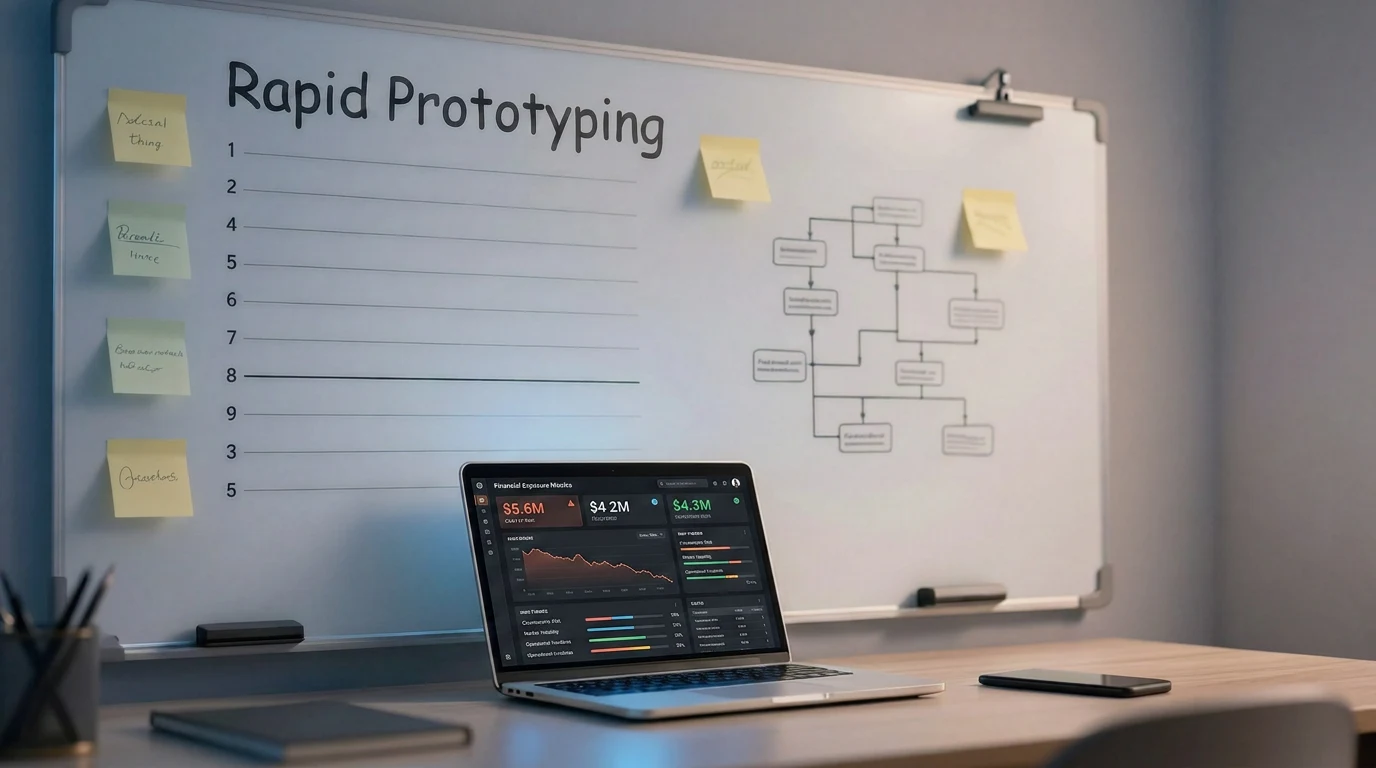
The AI landscape in 2026 is not the same as it was six months ago. New models drop. APIs break. What felt like a differentiator in January becomes a commodity feature by March. If you're building AI products with a traditional 12-to-18-month development cycle, you're not shipping products — you're shipping history.
At FrontierAI, we learned this the hard way. Early on, we spent four months designing a feature set around a specific model's capabilities. By the time we were ready to ship, the model had been deprecated and a successor changed the economics entirely. We had to throw out weeks of work and start over.
That experience forced us to rethink how we build. The answer we landed on: Rapid Prototyping in 90-day windows.
This post is about how we do it — the full workflow, the challenges specific to AI development, and the bridge from prototype to production.
The Core Problem with Building AI Products
Traditional software has mostly stable foundations. A PostgreSQL query that works today will work in a year. A React component doesn't suddenly change its behavior because OpenAI shipped a new release.
AI products don't enjoy that stability. Here's what we deal with constantly:
| Challenge | What it looks like | How often it hits us |
|---|---|---|
| Model deprecations | A model we've tuned prompts for gets retired with 90 days notice | Every 6–8 months |
| API behavior drift | Responses change subtly after a model update, breaking deterministic logic | Monthly |
| Cost volatility | Token pricing shifts, changing the viability of our architecture | Every quarter |
| Capability jumps | A new model makes our workarounds obsolete overnight | 3–4 times per year |
| Competitive compression | A feature that was novel becomes a ChatGPT built-in | Unpredictable |
The only sane response to this environment is to build in short cycles, validate fast, and avoid over-investing in anything before you know it works.
Our 90-Day Prototype Sprint
Every new product or major feature at FrontierAI goes through a structured 90-day window before we commit to full productization. The window is split into four phases.
Phase 1 — Discovery (Weeks 1–2)
Phase 2 — Planning (Weeks 3–4)
Phase 3 — Implementation (Weeks 5–10)
Phase 4 — Validation (Weeks 11–13)
Let's walk through each one.
Phase 1 — Discovery (Weeks 1–2)
Discovery is the most collaborative phase. The whole team — engineers, designers, and product — sits together (or in a shared async space) and brainstorms without constraints.
What we actually do:
- Run a two-day ideation session using structured prompts. Everyone generates 10 ideas. We vote, combine, and kill until we have 3 candidate concepts.
- For each candidate, we write a one-page Problem Statement answering: Who is the user? What pain are we solving? Why now? Why AI?
- We stress-test each concept against the AI risk matrix (see the table above). If a concept is entirely dependent on a single model's specific behavior, it gets flagged.
- We pick one concept to prototype.
Key output: A signed-off problem statement and a rough user journey map.
The most important rule in Discovery: don't let engineers pre-solve. It's tempting to jump to "we could use RAG for this" before you've confirmed the problem is worth solving.
Phase 2 — Planning (Weeks 3–4)
Planning translates the problem statement into something buildable. We don't write a full spec — that would take too long and lock us in. Instead we write a prototype brief.
The prototype brief includes:
- Success criteria — what does "good enough to validate" look like? We use metrics like task completion rate, user satisfaction score, and AI reliability (measured as % of responses that pass our quality threshold).
- Scope fence — explicitly what we are not building. This is as important as what we are building.
- AI model decision — which model(s) we'll use, and what the fallback plan is if it changes.
- Risks log — what could invalidate the prototype? We list at least five risks, including at least two AI-specific ones.
- Team allocation — who works on what. Typical sprint team is 2 engineers, 1 designer, and 0.5 of a product manager.
Time budget for a typical prototype:
| Area | Time allocation | Hours (est.) |
|---|---|---|
| Core AI integration & prompt engineering | 35% | ~168 hrs |
| Frontend / UX | 20% | ~96 hrs |
| Backend & data layer | 25% | ~120 hrs |
| Testing & evaluation | 15% | ~72 hrs |
| Documentation & handoff | 5% | ~24 hrs |
| Total | 100% | ~480 hrs |
Phase 3 — Implementation (Weeks 5–10)
This is where we build. Six weeks sounds short, but the scope fence from Planning makes it achievable.
Our implementation principles for AI products:
1. Build the eval harness first. Before writing a single feature, we define how we'll measure AI quality. We create a test set of 50–100 representative inputs with expected outputs. Every AI change gets benchmarked against this set. Without this, you're flying blind.
2. Use prompt versioning from day one. Every prompt lives in source control, versioned like code. We use a simple YAML format with the prompt text, the model it was tested against, and a quality score. When a model update causes a regression, we can roll back or branch.
3. Decouple the AI layer. We always build an abstraction layer between our application logic and the AI provider. This saved us multiple times — when we needed to swap models mid-sprint, it was a config change, not a rewrite.
4. Build for failure. AI calls fail. They time out, return garbage, and hallucinate. Our prototypes include degraded-mode behavior from the start: what does the user see when the AI can't produce a valid response?
5. Weekly internal demos. Every Friday, the sprint team demos the current state to the wider team. This keeps everyone aligned and surfaces problems early. We use a red/amber/green status based on how close we are to the success criteria.
Phase 4 — Validation (Weeks 11–13)
Validation is where the prototype gets stress-tested against reality. We run two parallel tracks:
Track A — Internal testing
The whole FrontierAI team uses the prototype in their real workflows for two weeks. We gather structured feedback using a short weekly survey (NPS + three open questions). We also monitor AI quality metrics from the eval harness.
Track B — External pilot
We recruit 5–10 users from our target segment and run moderated sessions in Week 11, then give them access for independent use in Weeks 12–13. We observe, ask questions, and resist the urge to explain or defend.
Validation decision framework:
At the end of Week 13, we hold a Go/No-Go meeting with a simple scorecard:
| Criterion | Target | Typical result |
|---|---|---|
| User task completion rate | ≥ 70% | 73% |
| AI quality pass rate | ≥ 85% | 88% |
| NPS from pilot users | ≥ 20 | 28 |
| Critical bugs | 0 | 0–2 |
| Evidence of core pain solved | Clear | Mostly clear |
If a prototype hits the targets, it moves to productization planning. If it misses on 2 or more, we either pivot the concept or park it.
The Bridge: From Prototype to Production
A prototype that works is not a product. The gap between the two is where most AI projects fail — either by shipping the prototype directly (technical debt, no scalability, gaps in safety) or by rebuilding from scratch and losing what they learned.
Our approach is a structured handoff process we call the Productization Plan, created at the end of Week 13 alongside the Go/No-Go decision.
The Productization Plan covers:
- What to keep — components, prompts, and data models that are production-quality as-is.
- What to rebuild — parts of the prototype that were intentionally rough.
- What to add — reliability, observability, security, and scale concerns not addressed in the prototype.
- Model strategy — long-term plan for model selection, fallback providers, and version locking.
- Estimated production timeline — typically 2–4x the prototype duration, depending on scale requirements.
Team Collaboration: How We Stay Aligned
One of the hardest things about rapid prototyping is keeping a cross-functional team coherent over 90 days. Here's what works for us:
Async-first, sync when it matters. We use Slack threads for daily updates and keep synchronous meetings to three per week: a Monday kickoff, a Wednesday mid-week check-in, and a Friday demo.
Roles are clear, boundaries are flexible. The sprint team has an explicit owner for each phase, but everyone is expected to contribute across disciplines. Engineers participate in discovery brainstorming. Designers help write test cases. This cross-pollination surfaces better ideas and prevents silos.
The PM owns the scope fence. When someone wants to add a feature mid-sprint ("what if we also added X?"), the PM is the keeper of the brief. The answer is almost always "log it for the productization plan."
AI-specific rituals:
- Monday model check — a 15-minute scan of recent model updates, API changelogs, and competitor AI feature releases. Keeps the team aware of the landscape without drowning in it.
- Thursday eval run — automated benchmark run every Thursday, results shared in Slack. Regressions get flagged immediately.
What Our Sprints Actually Look Like
Since adopting this model, we've run 8 full prototype sprints across a range of enterprise AI use cases. Here's the honest breakdown:
| Sprint | Concept | Outcome | Key learning |
|---|---|---|---|
| 1 | Liquidity | ✅ Shipped | Real-time financial data required a tighter eval harness than we anticipated — built it in week 4 |
| 2 | Business Intelligence | ✅ Shipped | Abstracting the AI layer early let us swap models mid-sprint without disrupting the frontend |
| 3 | Material Ordering Review | ✅ Shipped | Structured validation data made quality thresholds straightforward to hit |
| 4 | Leads Management | ⚠️ Pivoted | Data quality upstream made AI outputs unreliable; pivoted scope to data enrichment first |
| 5 | Sales AI | 🔄 In validation | High engagement from pilot users; finalising quality thresholds |
| 6 | CXO Intelligence | 🔄 In validation | Complex aggregation layer; validation extended by one week |
| 7 | Remittance | 🔄 In validation | Transaction reconciliation logic is proving robust; accuracy metrics above target |
| 8 | Photopack AI | ❌ Parked | Insufficient labelled training data to reach reliable condition-detection accuracy; revisiting when dataset grows |
7 out of 8 sprints are producing value — three shipped, four in active validation, one pivoted to a better framing, and one parked pending more training data. The two that didn't go as planned still generated learnings we've applied to every sprint since.
Getting Started
You don't need to adopt this entire framework at once. If you want to start somewhere, pick one:
- Start with the eval harness. Before your next AI feature, define what "good" looks like with 30 test cases. This single habit will change how you work.
- Set a scope fence. Write down three things your next project will explicitly not do. Then hold that line.
- Ship something in 6 weeks. Not a full product — a prototype that real users can touch. The feedback will be worth more than another month of planning.
The AI environment is only going to get more volatile. The teams that win will be the ones who learn fastest, not the ones who plan longest.
Frontier · Execution Intelligence